
How to Find Frederick County Inmate Records
Because there is no public county roster, you confirm custody through official channels. The fastest checks are a call to the jail and a search on Maryland VINE. VINE is free and anonymous, and it can tell you custody status and set up alerts. For people held in state prison or federal custody, you use separate locators. For charges, you pull the court case.
Have the person's full name ready, and an offender number if you have one. The steps below cover the common path for a Frederick County inmate records search.
- Call the Adult Detention Center at 301-600-2550 to verify custody.
- Search and register for alerts on Maryland VINE.
- For state prison custody, use the Maryland DPSCS incarcerated individual locator.
- For federal custody, use the Federal Bureau of Prisons locator.
- For charges and court dates, search Maryland Case Search.
The Frederick County Jail and Detention Center
The Adult Detention Center sits on Marcie's Choice Lane, apart from the downtown courthouse and from Sheriff's headquarters on Airport Drive East. It opened in October 1984 and now holds 468 beds across general population, special units, and work release, with 203 cells. The Sheriff's Office runs the facility as a full-service jail that also offers alternatives like Pretrial Services, Home Detention, Alternative Sentencing, and Work Release.
The Corrections Bureau employs nearly 200 people across administrative services, community services, inmate services, and security operations. Security staff cover the Detention Center and the Central Booking Unit around the clock. The two contact points below help with custody questions.
Adult Detention Center
7300 Marcie's Choice Lane
Frederick, MD 21704
301-600-2550
Fax 301-600-3066
Sheriff's Office (custody line)
110 Airport Drive East
Frederick, MD 21701
301-600-1046 (24-hour)
Non-emergency 301-600-2071
What Frederick County Inmate Records Show
Because the county does not publish a roster, there is no public profile screen to copy. Jail staff keep detailed internal files, but the public-facing data is limited. When custody status is available through the jail or VINE, expect a small set of fields. The table lists what you can usually confirm.
| Field | What It Shows |
|---|---|
| Offender Name | The name on record for the person in custody. |
| Offender Number | An identifier used to track custody. |
| Custody Status | Whether the person is currently held. |
| Facility | The facility holding the person. |
| Notification Options | Alerts you can set through VINE. |
| Release / Transfer | Status changes when reported. |
Charges and bond are not reliable from a custody record. Confirm those through the court case. The internal records staff maintain include intake screening, housing, classification, detainers, victim notification, DNA collection, and release tracking, but those are not public online.
Maryland VINE Custody Notifications
Maryland VINE is the main tool for tracking a person in custody. The state describes it as free, confidential, and available by phone, website, or app. You can check custody, court case, and protective order status, and register for alerts by phone, email, text, TTY, or in-app. The person in custody will not know that someone has registered.
VINELink is the website version of the service.
Open VINELink to search and register.
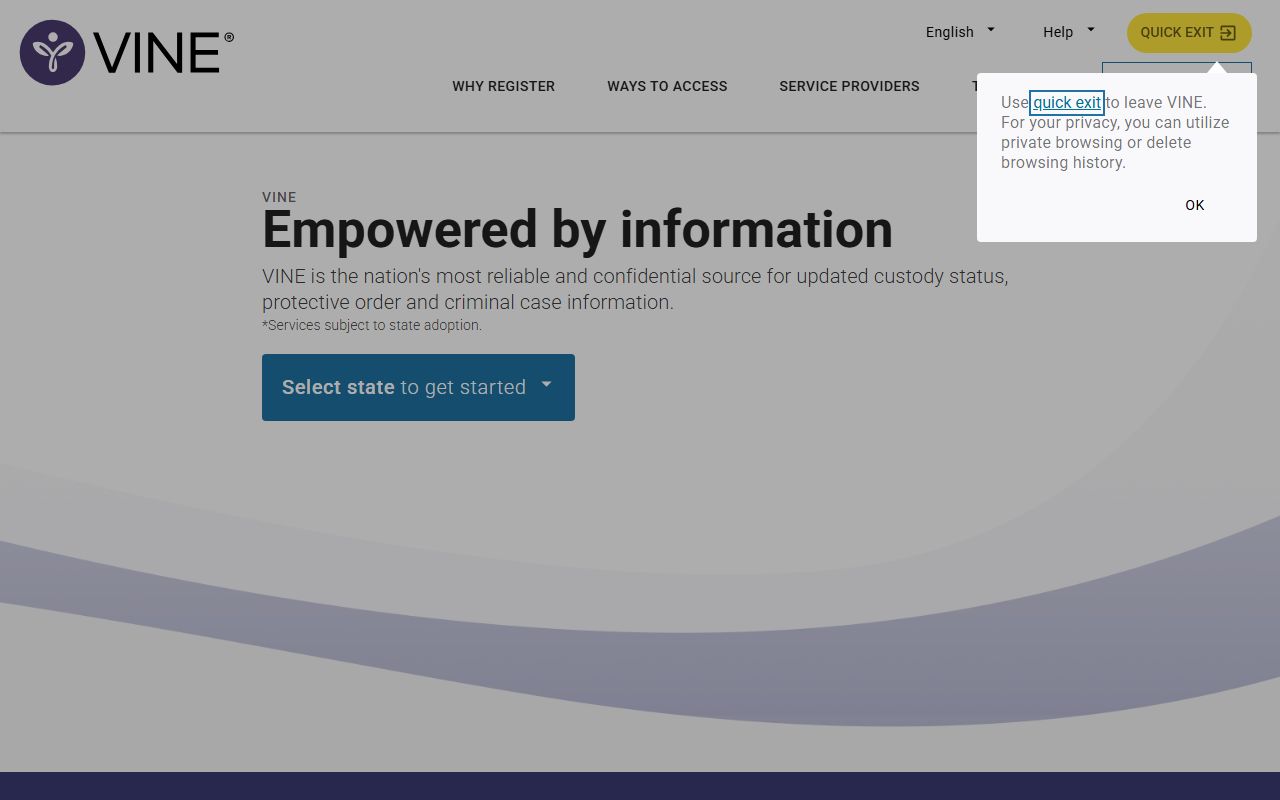
Custody alerts cover release, escape, transfer, and probation or parole status. Phone users set a four-digit PIN.
The fields below come from the VINE service.
| Field Label | Type | Required | Notes / Format |
|---|---|---|---|
| Search category | Selection | Yes | Offender custody, court case, or protective order. |
| Offender Name | Text | Yes (custody) | Used for custody information. |
| Offender Number | Text | No | Used for custody tracking when known. |
| Notification method | Selection | Registration | Phone, email, text, TTY, or in-app. |
| PIN | Numeric | Phone registration | A four-digit PIN for phone notifications. |
Do not register a switchboard number. If you miss a notification call, VINE leaves a message and keeps trying for at least 24 hours.
State and Federal Inmate Searches
Not everyone arrested in Frederick County stays at the county jail. People sentenced to longer terms move to state prison, and federal defendants go into the federal system. Each has its own locator. The Maryland Division of Corrections tracks state custody, and the Federal Bureau of Prisons tracks federal custody from 1982 to the present.
The federal locator searches by name or by number.
Use the Federal Bureau of Prisons inmate locator for federal custody.
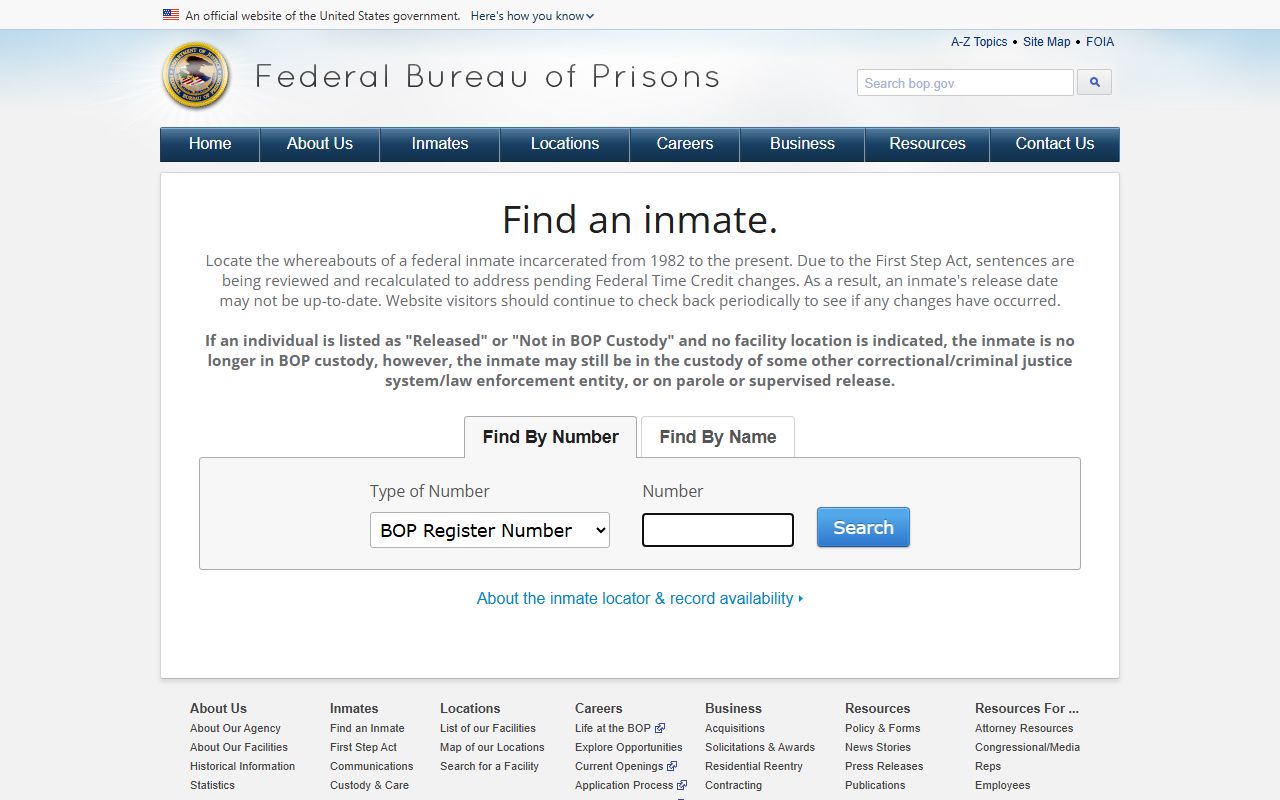
The BOP warns that release dates can change due to sentence recalculation, and that a person shown as released may still be under supervision elsewhere. For people released from the county jail, see the Frederick County released inmates page.
Frederick County Inmate Booking and Central Booking
Most arrests in the county run through Central Booking, a shared intake function. The annual report says that, except for positive identification, Central Booking processing is usually finished before the officer wraps up the law-enforcement part of the arrest. That means the county uses one central intake rather than long-term housing at each police department.
In 2023 Central Booking processed 2,503 people and committed 1,244 to the Detention Center, about 49.7 percent. By agency, the Sheriff's Office accounted for 1,347 of those processed, Frederick City Police 895, and the Maryland State Police 205, with smaller numbers from Thurmont, Brunswick, and Mt. Airy. A body scanner installed in 2015 screens people entering the facility for contraband. A Transportation Unit with seven vehicles moves prisoners to and from courts, medical visits, and evaluations across Maryland.
Frederick County Inmate Bond and Video Review
A newly booked person often appears before a commissioner or judge by video. The Corrections Bureau uses a video system for bond hearings, bond reviews, and extradition hearings. That is why a family may not see a physical transport to court for an early review. Bond conditions are set by the court.
Pretrial Services reviews eligible defendants who await trial and monitors nonviolent people in the community. In 2023 it reviewed 1,327 defendants, prepared 210 bond reports, and reported only four failures to appear. To follow bond and court dates, search the Frederick County court records, and for active warrants see warrant records.
Frederick County Jail Medical and Classification
The jail is more than a secure building. Classification specialists handle intakes, housing, work and program assignments, release preparation, detainers, victim notification, and DNA collection. Medical and mental-health care is contracted to a provider, and the facility holds accreditation from the National Commission on Correctional Health Care.
Nursing staff are on duty around the clock, a physician or physician assistant is on call and visits at least five days a week, and dental and radiology services are available. The 2023 medical statistics reported 1,745 intake screenings, 4,209 nurse sick calls, 416 mental-health evaluations, and zero deaths in custody. Population data sits on the Frederick County jail population page.
Technology runs much of daily contact. The facility uses tablets, video visits, and phones, and a new jail management system tracks each stay from intake to release. The 2023 report counted 68,670 video visits, 333,979 phone calls, and 365,805 text messages across the year. Those numbers show why tablet and video systems matter for families trying to stay in touch with a Frederick County inmate.
Visiting a Frederick County Inmate
Visits are scheduled by group, and the days differ for males, females, juveniles, and work release. Visitors need current photo identification and proof of age, must register before entry, and registration closes one half hour before the period ends. One 30-minute visit per week is allowed, with up to four visitors. Visitors under 18 must come with an adult unless they are the inmate's spouse.
| Group | Days and Times |
|---|---|
| Juveniles | Thursday 12:30 p.m. to 7:00 p.m. |
| Females | Tuesday 12:30 p.m. to 7:30 p.m.; Saturday 9:00 a.m. to 4:00 p.m. |
| Males | Sunday 9:00 a.m. to 4:00 p.m.; Mon, Wed, Thu 12:30 p.m. to 7:30 p.m. |
| Work Release | Tuesday and Saturday evening windows; Saturday morning |
Video visits use HomeWAV, with one free visit per week at the facility or paid remote visits from home for a per-minute rate. Cell phones and cameras are not allowed in the visitation area, bags must stay in your vehicle or a lobby locker, and all visitors and vehicles can be searched. A contraband attempt can lead to arrest and a loss of visiting rights, so read the rules before your first visit.
Mail and Money for Frederick County Inmates
Mail does not go straight to the Frederick jail. All mail routes through USPS to a processing address in San Antonio, Texas, where it is scanned onto inmate tablets. Use the inmate's name and AR number, keep each envelope to 10 pages no larger than 8.5 by 11 inches, and skip anything with glitter, tape, or explicit content. No cash, checks, or money orders may be mailed. The address format reads as the facility name, the inmate name and AR number, the PO box, and the San Antonio ZIP, so confirm the current mailing details with the jail before you send anything.
Calls are outgoing collect calls, set up through a prepaid Pay Tel account. Money for commissary goes through a kiosk in the visitation lobby or online, using cash or a card, with no mailed funds accepted. The released inmates page covers property return after release, and the FAQ answers more custody questions.