
How to Search for a Frederick County Warrant
There is no public button that lists every open warrant. Maryland access guidance treats unserved arrest warrants as not open to public inspection without a court order or legal authority. So a warrant search is really a set of careful checks. You contact the court, you contact the Sheriff, and you watch the court case once it becomes public.
Do not rely on third-party warrant sites. They are not official and may be wrong or out of date.
Important: Many websites claim to list Frederick County warrants. Those are not official. Confirm any warrant only through the issuing court, the Sheriff's Office, or an attorney.
- Contact the court clerk that handled the related case.
- Contact the Sheriff's Office through its non-emergency line at 301-600-2071.
- Speak with a licensed attorney about your options.
- If a case is public, check it on Maryland Case Search for warrant-related docket events.
- Keep written proof of any recall or resolution.
Why Frederick County Warrants Stay Private
An unserved warrant is sensitive for a reason. If open warrants were posted, a person could learn of an arrest plan and flee. Maryland law and court access rules keep unserved arrest warrants out of public systems. The same logic applies to unserved protective orders. This is not a gap in the records; it is a privacy and safety rule built into Maryland practice.
Once a warrant is served and the case is docketed, the public court record can show related events. At that point, Case Search may list a bench warrant entry, a failure-to-appear note, or a recall. Until then, official confirmation comes only from the court or the Sheriff.
The Sheriff's Office runs a tips line at 301-600-4131 for community information, and the non-emergency dispatch line at 301-600-2071 handles routine calls. Neither line is a warrant lookup, but both are official ways to reach the agency. If you have a real safety concern about a warrant or a wanted person, call 911 rather than searching online. Treat any site that promises a full Frederick County warrant list as unreliable.
Note: A warrant can stay active for a long time, so an old missed court date may still carry a bench warrant until the court recalls it.
Types of Frederick County Warrants and Holds
Warrant is a broad word. Several kinds can show up in a Frederick County case, and each one works a little differently. Knowing the type helps you ask the right office the right question.
- Arrest warrant - authorizes an arrest based on a charging document and probable cause.
- Bench warrant - issued by a judge, often for a missed court date or contempt.
- Search warrant - authorizes a search of a place, person, or property.
- Fugitive warrant or detainer - a hold for another jurisdiction.
- Violation warrant - for a probation, parole, or pretrial supervision violation.
- Civil body attachment - may arise in support or civil enforcement matters.
What a Frederick County Warrant Record Shows
No official public warrant listing was found for Frederick County, so there is no sample screen to copy. If warrant information appears in a court file after service, it usually includes a set of common fields. The table below shows the fields you may see in the court record once a warrant is part of a public case.
| Field | What It Shows |
|---|---|
| Case Number | The related court case identifier. |
| Defendant / Respondent | The named subject of the warrant. |
| Issuing Court | District Court or Circuit Court. |
| Warrant Type | Arrest, bench, search, or violation. |
| Issue Date | When the court issued the warrant. |
| Charge / Basis | The charge or order behind the warrant. |
| Service Status | Whether the warrant was served. |
| Bond Condition | Bond, no bond, or release terms. |
| Recall / Quash | A note if the warrant was withdrawn. |
How to Resolve a Frederick County Warrant
If you believe you have an outstanding warrant, act quickly and carefully. A bench warrant for a missed date can often be addressed by scheduling, but the steps depend on the case. Talk with an attorney before you take action.
- Do not rely on third-party websites; contact the issuing court, the Sheriff, or an attorney.
- If the warrant ties to a Frederick court case, find the case number on Case Search when public.
- Ask whether the matter can be scheduled, recalled, or addressed by motion.
- For a failure-to-appear, be ready to explain the missed date and update your address.
- For a bondable warrant, confirm the bond amount and type before you try to post it.
- If you turn yourself in, arrange transportation, work, childcare, and counsel first.
- After resolution, confirm the docket update and keep written proof.
Bond and the Commissioner Process
A newly arrested person may see a court commissioner or a judge soon after booking. The Adult Detention Center uses a video system for bond hearings, bond reviews, and extradition hearings. That is why a family member may not see a physical transport to court for an early review. Bond decisions and conditions are set by the court, not the jail.
Pretrial Services reviews many defendants who await trial and monitors eligible nonviolent people in the community. For custody status and how booking works, see the Frederick County inmate records page, and for charges and outcomes use court records.
The Maryland Sex Offender Registry
One public safety database does exist statewide. The Maryland Department of Public Safety and Correctional Services runs the sex offender registry, which lets the public search by area, address, name, or city. It helps families see registered offenders living or working nearby and sign up for movement alerts.
The DPSCS page links to the registry search and explains its purpose.
Open the Maryland sex offender registry to search.
The registry warns that data is self-reported, that positive identification comes only through fingerprints, and that the information may not be used to harass anyone.
The fields below come from the registry's search behavior.
| Field Label | Type | Required | Notes / Format |
|---|---|---|---|
| Search method | Tab/Button | Yes | Area, name, city/ZIP, or map. |
| Last Name | Text | Usually yes (name search) | Used for registrant name search. |
| First Name | Text | No | May accept partial names or aliases. |
| Address / Location | Text | No | Home, school, or work address for a radius search. |
| City / ZIP | Text | No | City or ZIP area search. |
| Radius | Dropdown | No | Distance for home-area alerts. |
The registration framework sits in Maryland's sex offender statutes.
See Criminal Procedure § 11-701 for the registration definitions.
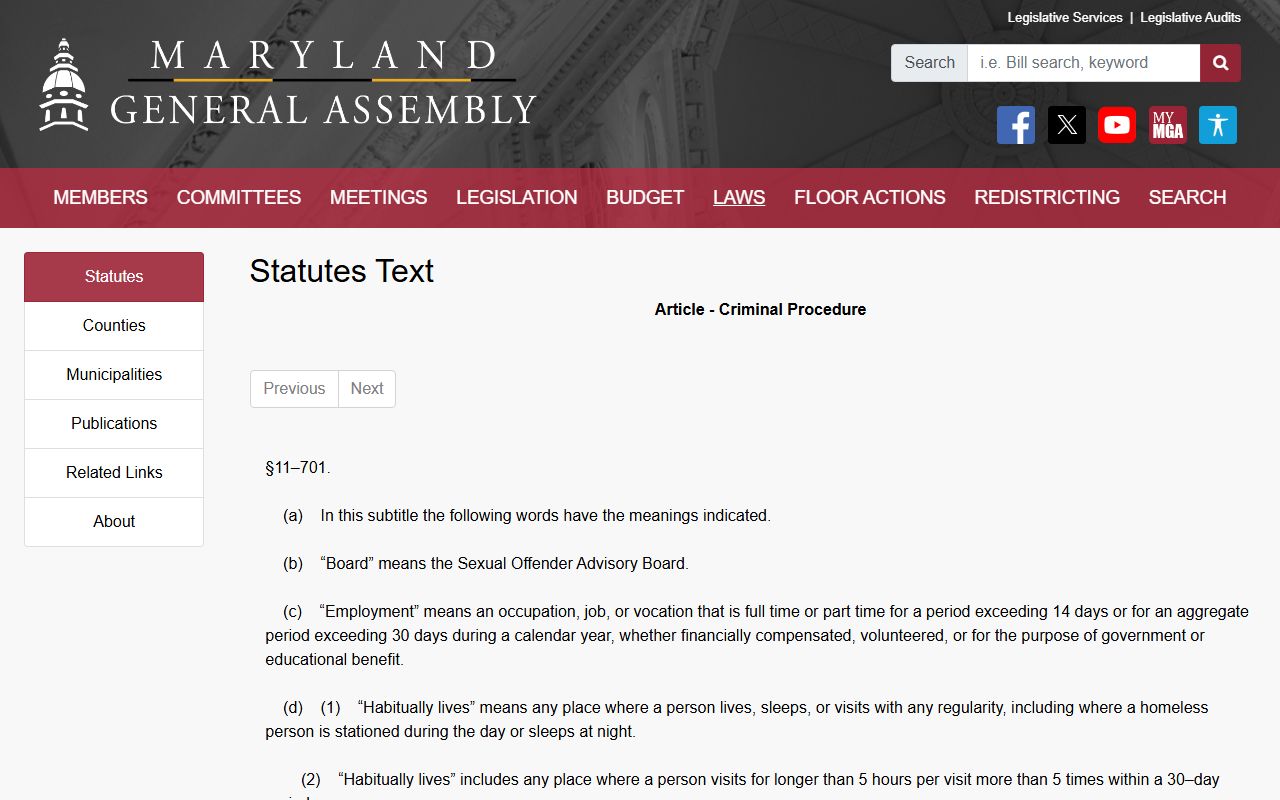
A missing result for a ZIP does not prove no registrant is present, so use the registry as one tool among several.
Extreme Risk and Protective Order Shielding
Some orders that involve law enforcement are shielded from public view. Maryland courts access guidance cites a Public Safety section for extreme risk protective order shielding. These orders, sometimes called red flag orders, can limit access to firearms in a crisis, and the records are protected in set circumstances.
The shielding rule sits in Maryland's public safety statutes.
See Public Safety § 5-602 for extreme risk protective order shielding.
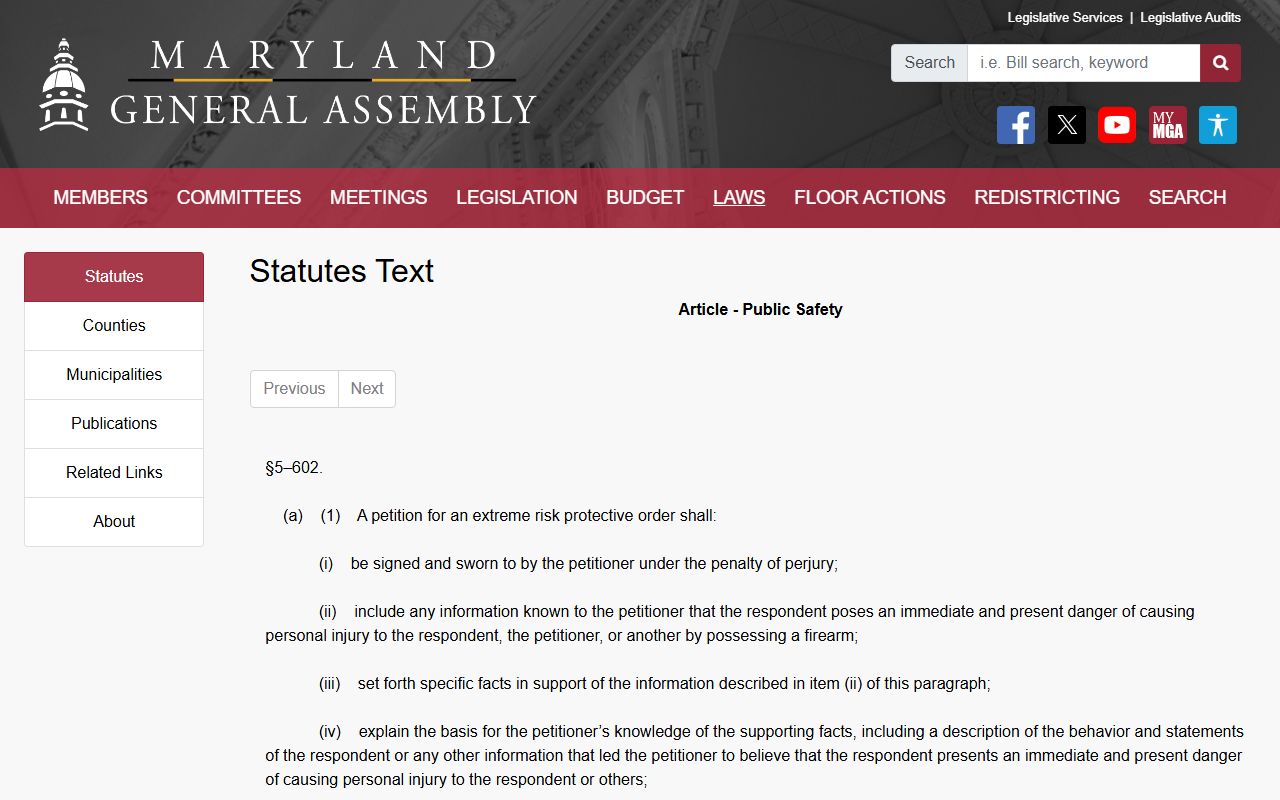
Because these matters are sensitive, the records may not appear in public systems, and access often requires a court order. More on restricted records sits on the Frederick County arrest records page.